

Views: 1 Author: Site Editor Publish Time: 2026-10-26 Origin: Site


In 2026, driven by the explosive convergence of global digital transformation, artificial intelligence (AI), large language models (LLMs), and hyper-scale cloud computing, data centers have evolved into the core infrastructure of the modern digital economy. However, this transition to high-density computing has created unprecedented electrical power demands. Power density per rack has escalated dramatically from 5kW–10kW just a few years ago to over 30kW to 100kW today. Consequently, an enterprise or hyperscale data center can easily require dozens to hundreds of megawatts (MW) of total electrical capacity. In this high-demand environment, electrical power stability directly dictates operational survival. Even a microsecond voltage sag, frequency transient, or a brief utility power outage can trigger catastrophic server crashes, corrupted databases, process interruptions, and millions of dollars in SLA penalty liabilities.
To defend against unpredictable utility grid collapse, extreme weather events, and regional blackouts, global certification bodies such as the Uptime Institute mandate rigorous fault-tolerant standards (Tier III and Tier IV), requiring 99.999% availability ("Five Nines"). Achieving this degree of power resilience requires a multi-layered defense architecture where Uninterruptible Power Supply (UPS) systems handle instantaneous utility-to-battery bridging (typically 5 to 15 minutes), while a heavy-duty diesel generator infrastructure handles prolonged, continuous full-load power generation.
In this mission-critical environment, a data center backup generator is not merely an emergency backup accessory; it operates as an autonomous, high-capacity micro-power plant. Upon sensing a utility power failure, the engine-generator set must cold-start, accelerate, establish rated voltage, synchronize, and accept full critical facility loads within 10 to 15 seconds through Automatic Transfer Switches (ATS) and master paralleling controls. This intense process demands exceptional engine transient response, pristine power quality, high block-load acceptance, and extreme mechanical durability. As regional utility grids face mounting instability from aging infrastructure and intermittent renewable energy integration, the strategic value of specialized generator assembly plants has never been higher. Only manufacturers with deep domain expertise in data center load characteristics can engineer gensets capable of supporting critical digital infrastructure.
Sizing and specifying generator sets for modern data centers is a highly sophisticated engineering task that extends far beyond matching nameplate engine horsepower. Data center electrical loads are non-linear, dominated by UPS rectifiers, variable frequency drives (VFDs) for cooling infrastructure, and switched-mode server power supplies. These non-linear loads inject high harmonic distortion back into the generator alterator, causing excessive winding heating and potential voltage instability. Furthermore, during a power transition, the generator must accept massive block loads or stepped load steps without exceeding strict voltage and frequency tolerances.
Power rating definitions are the first crucial factor. Under ISO 8528 standards, generator output ratings are classified as Emergency Standby Power (ESP), Limited-Time Prime Power (LTP), Continuous Power (COP), and Data Center Continuous (DCC) power. Data center engineering teams should prioritize units with independent DCC certification. DCC-rated gensets are certified to run at 100% of their rated capacity continuously with no operational time limit and zero power derating requirements during extended utility outages, providing an essential safeguard during multi-day grid blackouts.
Second, engine transient performance—specifically ISO 8528-5 Class G3 compliance—is the benchmark for successful selection. Class G3 is engineered specifically for sensitive facilities like data centers where voltage and frequency deviations must remain extremely tight. When subjected to a 100% sudden load application or severe load steps, the engine's transient voltage dip, frequency drop, and recovery time must recover rapidly within specified limits. Achieving this level of performance requires assembly plants to integrate state-of-the-art engines featuring High-Pressure Common Rail (HPCR) fuel injection and advanced Electronic Control Units (ECUs), paired with premium brushless alternators designed with low subtransient reactance (X"d) to minimize harmonic distortion.
Thermal management and environmental adaptation are equally vital. Gensets are often installed in basements, rooftops, or outdoor acoustic enclosures where extreme ambient temperatures, high altitudes, and duct static pressure can cause severe thermal derating. Assembly plants must employ Computational Fluid Dynamics (CFD) modeling to engineer custom cooling packages, heavy-duty radiators, and optimized fan drive systems, ensuring 100% full-power output even at 50°C (122°F) ambient temperatures.
Table 1: ISO 8528 Generator Power Rating Comparison for Data Center Applications
| Power Rating Standard | Annual Operating Limit | Average Load Factor | Transient Overload Capability | Data Center Suitability |
| Emergency Standby Power (ESP) | < 200 Hours / Year | ≤ 70% | No continuous overload | Non-critical auxiliary support only |
| Continuous Power (COP) | Unlimited (Continuous) | 100% Continuous | No overload capability | Base-load continuous generation |
| Data Center Continuous (DCC) | Unlimited (Continuous) | 100% Continuous | High transient block-load acceptance | Preferred standard for Tier III/IV data centers |
Section 3: Custom Assembly Precision, Structural Engineering, and Advanced Noise Attenuation
An industrial generator set is far more than a basic engine and alternator bolted together; it is a highly integrated electro-mechanical system requiring precision engineering. As a specialized assembly plant, meticulous process control directly dictates the operational reliability and vibration resistance of the genset over its 20-year design life. During manufacturing, laser-guided coaxial alignment between the engine flywheel and alternator rotor is paramount. Radial or axial misalignment measured in fractions of a millimeter can induce severe structural vibration, causing premature bearing failure, fastener loosening, or crankshaft fatigue over extended operation.
Vibration isolation and skid engineering play a fundamental role in protecting facility infrastructure. During startup and heavy load acceptance, high-displacement diesel engines produce substantial dynamic forces. Factory engineers calculate the exact center of gravity and weight distribution to position high-deflection elastomeric or spring vibration isolators beneath the skid, preventing low-frequency vibrations from transmitting into the surrounding facility structure and delicate IT hardware. Furthermore, integrated sub-base fuel tanks are custom-built with double-wall containment, anti-corrosion interior coatings, leak detection sensors, and automated fuel transfer systems to maintain an uninterrupted 8- to 24-hour full-load fuel reserve on-site.
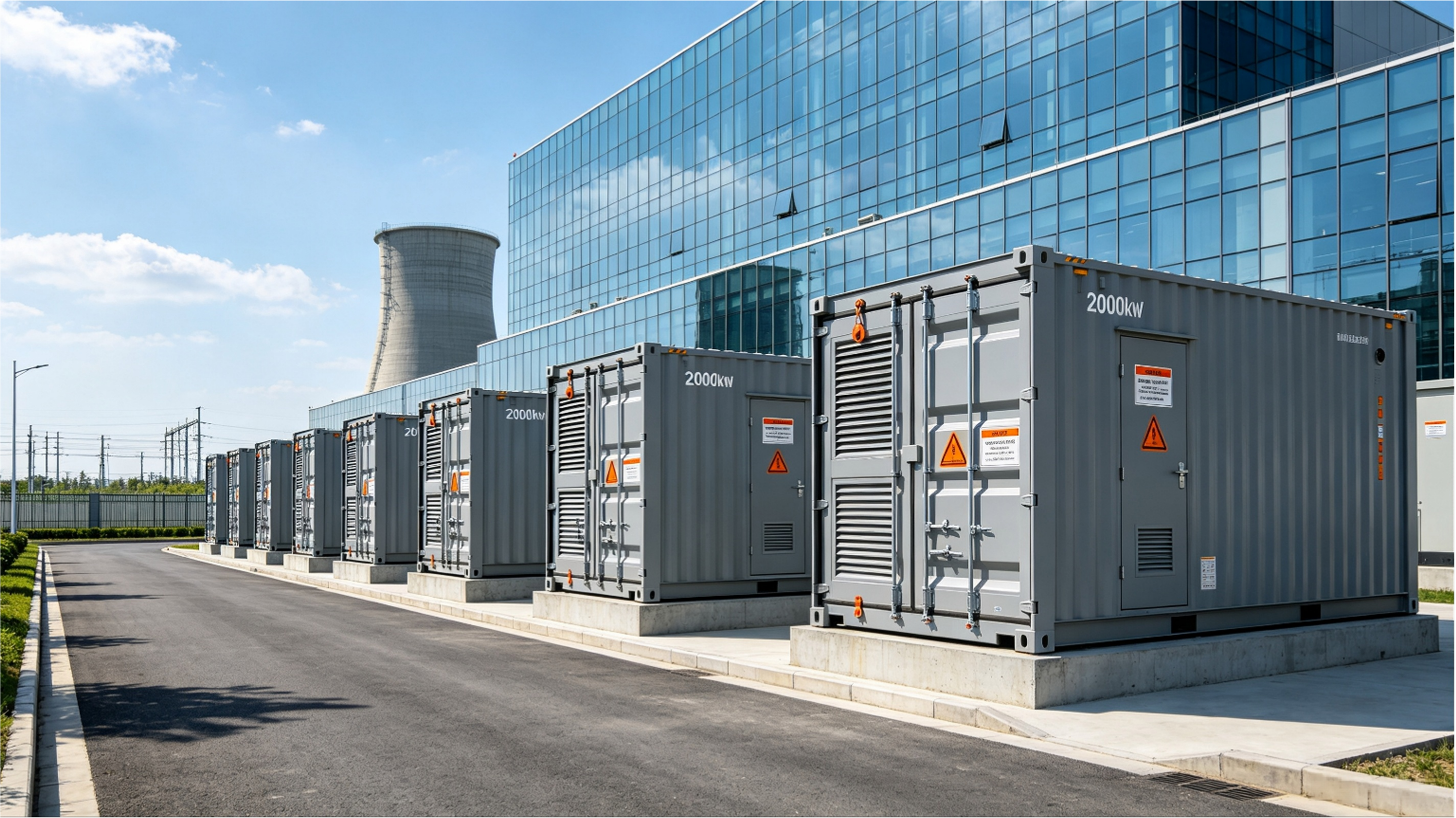
Acoustic attenuation represents another critical challenge in urban and suburban data center developments. Municipal environmental codes often enforce strict noise limits (frequently requiring ambient levels below 55–65 dBA at property boundaries). To meet these regulations, the containerized generator has emerged as the industry gold standard. These heavy-duty units enclose the complete generator set, cooling system, sub-base fuel tank, digital control panels, and sound attenuation baffles within a standard 20-foot, 40-foot, or custom ISO high-cube container.
Acoustic performance inside a containerized enclosure relies on specialized sound engineering. The internal container walls are lined with high-density, fire-retardant mineral wool insulation faced with perforated aluminum sheets, effectively trapping and dampening mid- to high-frequency mechanical noise. Inlet and discharge air paths are routed through engineered acoustic louvers and labyrinth baffles that allow sufficient airflow for engine cooling while forcing sound waves to dissipate through multiple reflective passes. Additionally, critical-grade or hospital-grade exhaust silencers are integrated within the container envelope to suppress intense engine exhaust pulses. Through these advanced acoustic engineering techniques, containerized gensets consistently achieve sound levels as low as 70–75 dBA at 7 meters under full load, combining ultra-quiet operation with rugged, weatherproof outdoor protection.
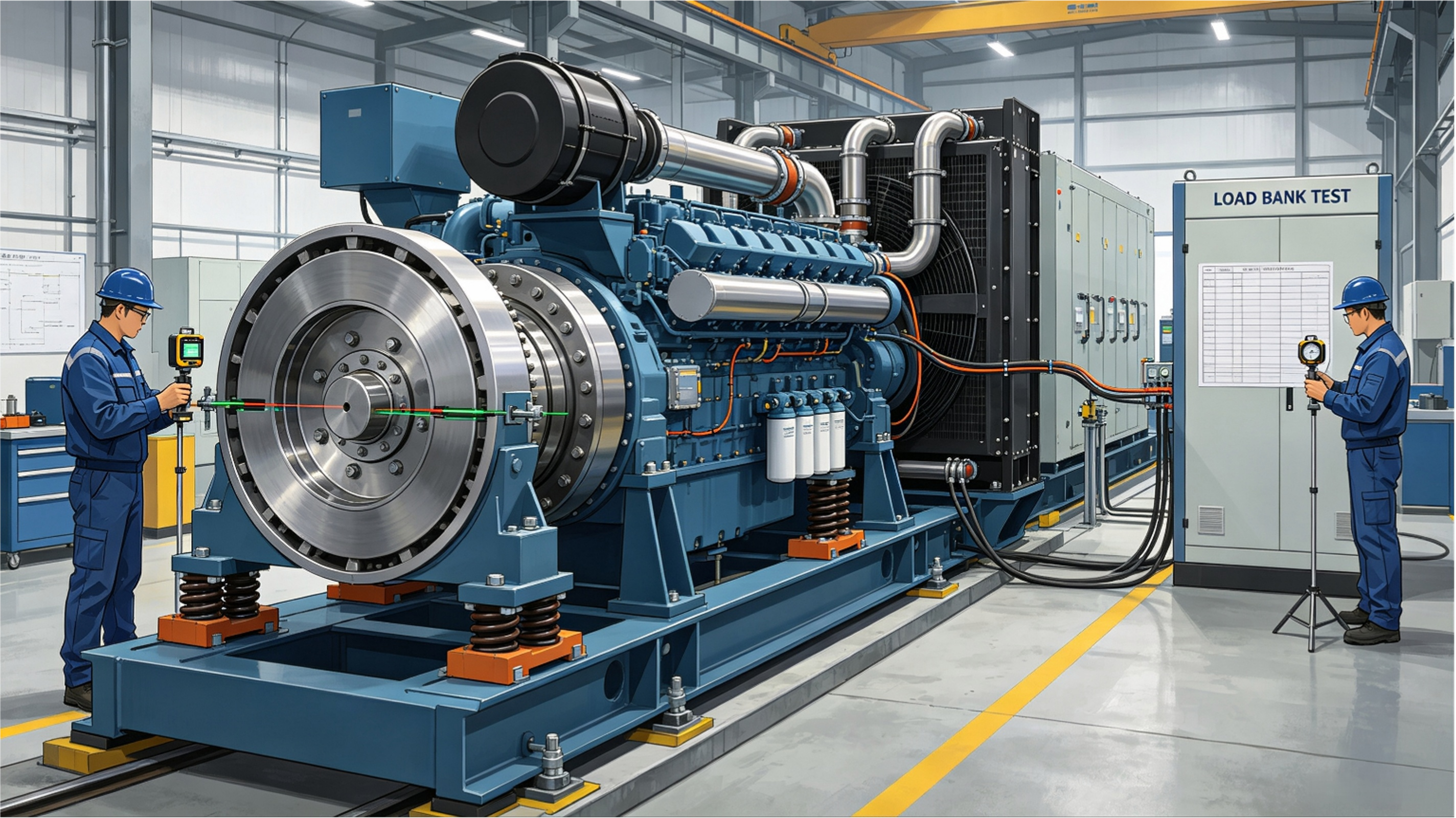
The absolute zero-downtime tolerance of data center infrastructure demands that every generator set undergo comprehensive Factory Acceptance Testing (FAT) before dispatch. Shipping an untested or partially tested generator set to a critical site creates unacceptable operational risk. A premier assembly facility must maintain an advanced testing center equipped with high-capacity low-voltage and medium-voltage load banks, enabling multi-hour resistive and reactive full-load testing under simulated real-world conditions.
The testing protocol begins with static inspection, cold insulation resistance checks, phase rotation validation, and sensor calibration. It then progresses to dynamic performance testing, including no-load warm-up, step-load acceptance at 25%, 50%, 75%, and 100% rated capacity. Throughout these tests, automated Supervisory Control and Data Acquisition (SCADA) systems log critical engine and electrical parameters at millisecond intervals—including voltage stability, frequency regulation, total harmonic distortion (THD), exhaust gas temperatures, oil pressure, and coolant temperature.
For data center applications, testing must include a 110% overload test, 100% instantaneous block-load application/rejection tests, and a multi-hour thermal saturation run at maximum continuous load. These tests verify that the engine governor and Automatic Voltage Regulator (AVR) recover instantly from sudden load steps. Furthermore, multi-unit systems undergo factory paralleling logic checks, active and reactive load-sharing validation, and simulated single-unit fault rejection tests. Only units that pass every FAT benchmark receive factory certification, forming the bedrock of our manufacturing quality guarantee.
As data center power loads expand into the tens or hundreds of megawatts, single generator units are no longer sufficient. Multi-unit paralleling systems have become standard practice, tying multiple generator outputs together onto a synchronized low-voltage or medium-voltage bus. This architecture provides scalable power capacity and redundant backup configurations (such as N+1, N+2, or 2N topologies). Achieving seamless paralleling requires advanced digital intelligence at the generator controller level.
Modern gensets incorporate micro-computer controllers (such as Deep Sea, ComAp, or Woodward) that communicate over high-speed CANbus networks to achieve sub-second frequency and phase matching. Upon receiving a start command, the controller adjusts engine fueling and alternator excitation in milliseconds, matching the incoming unit's voltage, frequency, and phase angle precisely with the live bus before closing the circuit breaker. Furthermore, intelligent load management features automatically calculate overall facility demand, starting or stopping individual gensets (Load Demand Auto-Start/Stop) to ensure running units operate at peak fuel efficiency.
The Automatic Transfer Switch (ATS) serves as the primary intelligence link between the utility grid and the emergency generator plant. The ATS continuously monitors utility grid health. Upon detecting a fault—such as phase loss, under-voltage, over-voltage, or frequency instability—the ATS instantly signals the generator plant to start. Once the generator bus stabilizes, the ATS executes a fast, automated transfer of the critical load to generator power. When grid power stabilizes, the ATS transfers the load back seamlessly, running the generators through an unloader cool-down cycle before shutting them down automatically.
For ongoing operational maintenance, the integration of Internet of Things (IoT) technology and predictive analytics has transformed traditional maintenance routines. By mounting wireless vibration sensors, continuous oil quality monitors, and bearing temperature probes throughout the genset, real-time operating data is streamed to cloud-based monitoring platforms. Advanced machine learning algorithms analyze this data to identify subtle pre-fault signatures—such as injector fouling, filter restriction, or battery degradation—long before a failure occurs. Transitioning from reactive maintenance to Condition-Based Predictive Maintenance (PdM) dramatically reinforces overall data center power availability.
While power resilience remains the top priority, global data center operators are under increasing pressure to achieve aggressive ESG (Environmental, Social, and Governance) targets and net-zero carbon goals. The carbon emissions, nitrogen oxides (NOx), and particulate matter (PM) generated during routine generator exercise runs and emergency operations are subject to strict regulatory oversight. Forward-thinking assembly plants are proactively integrating clean technologies to transition gensets toward low-emission and renewable fuel compatibility.
Dual-fuel system technology provides a mature, highly efficient transition pathway. Dual-fuel conversion kits allow standard engines to operate on a mixture of natural gas (NG) or pipeline methane and diesel fuel, using a small diesel pilot injection (typically 15% to 30%) for ignition. This mode reduces overall diesel consumption, lowers on-site fuel storage requirements, cuts particulate emissions by up to 80%, and significantly reduces net carbon emissions, all while preserving the rapid start times and load acceptance characteristics of traditional diesel engines.
Concurrently, the rapid adoption of Hydrotreated Vegetable Oil (HVO)—a second-generation renewable biofuel—is creating a direct path toward net-zero emergency power generation. HVO is a synthetic paraffinic diesel produced from waste fats and vegetable oils through hydrotreatment, resulting in a chemical structure nearly identical to fossil diesel but virtually free of sulfur and aromatics. Crucially, modern high-performance diesel generator sets can run on 100% HVO as a "drop-in" fuel without requiring any engine hardware modifications or power derating. Using HVO cuts lifecycle net carbon emissions by up to 90% compared to conventional diesel and offers an extended shelf life without fuel degradation or microbial growth issues. By engineering gensets for HVO compatibility and dual-fuel operation, assembly plants are transforming traditional backup power into a sustainable, zero-carbon microgrid asset.
Table 2: Fuel Technology and Environmental Emission Profile Comparison
| Fuel / Power Technology | CO2 Emission Reduction | PM & NOx Emissions Reduction | Fuel Storage Stability | Hardware Modification Required |
| Standard Fossil Diesel | Baseline (0%) | Baseline (100%) | 6 – 12 Months (Degradation risk) | None (Standard OEM configuration) |
| Dual-Fuel System (NG / Diesel) | 15% – 25% Lower | 70% – 80% Lower PM | Continuous pipeline natural gas supply | External gas train and controls required |
| Hydrotreated Vegetable Oil (HVO) | Up to 90% Lower | Significantly Reduced (Sulfur-free) | Up to 10 Years (Ultra-stable) | 100% Direct Drop-in (Zero modifications) |
Building true data center power resilience is an all-encompassing engineering challenge. From millisecond UPS bridging to 10-second automatic diesel generator starting, and from sustaining high-density server loads with a data center backup generator to meeting strict sound abatement codes using a heavy-duty containerized generator, every component must perform flawlessly.
For data center developers, EPC contractors, and facility engineers, partnering with a specialized generator assembly plant that offers strong engineering capabilities, strict FAT quality control, and global technical support is vital. A premier assembly partner serves as a collaborative solutions architect, helping optimize cooling package design, paralleling logic, and acoustic treatment early in the engineering phase to minimize both initial Capital Expenditure (CAPEX) and long-term Operational Expenditure (OPEX).
In 2026, where computing power defines global competitiveness, our factory remains committed to precision engineering, deep partnerships with leading engine and alternator brands, and continuous innovation in low-emission backup power. We stand ready to supply robust, highly reliable emergency power systems for hyperscale data centers, AI computing hubs, and mission-critical facilities around the world.


